
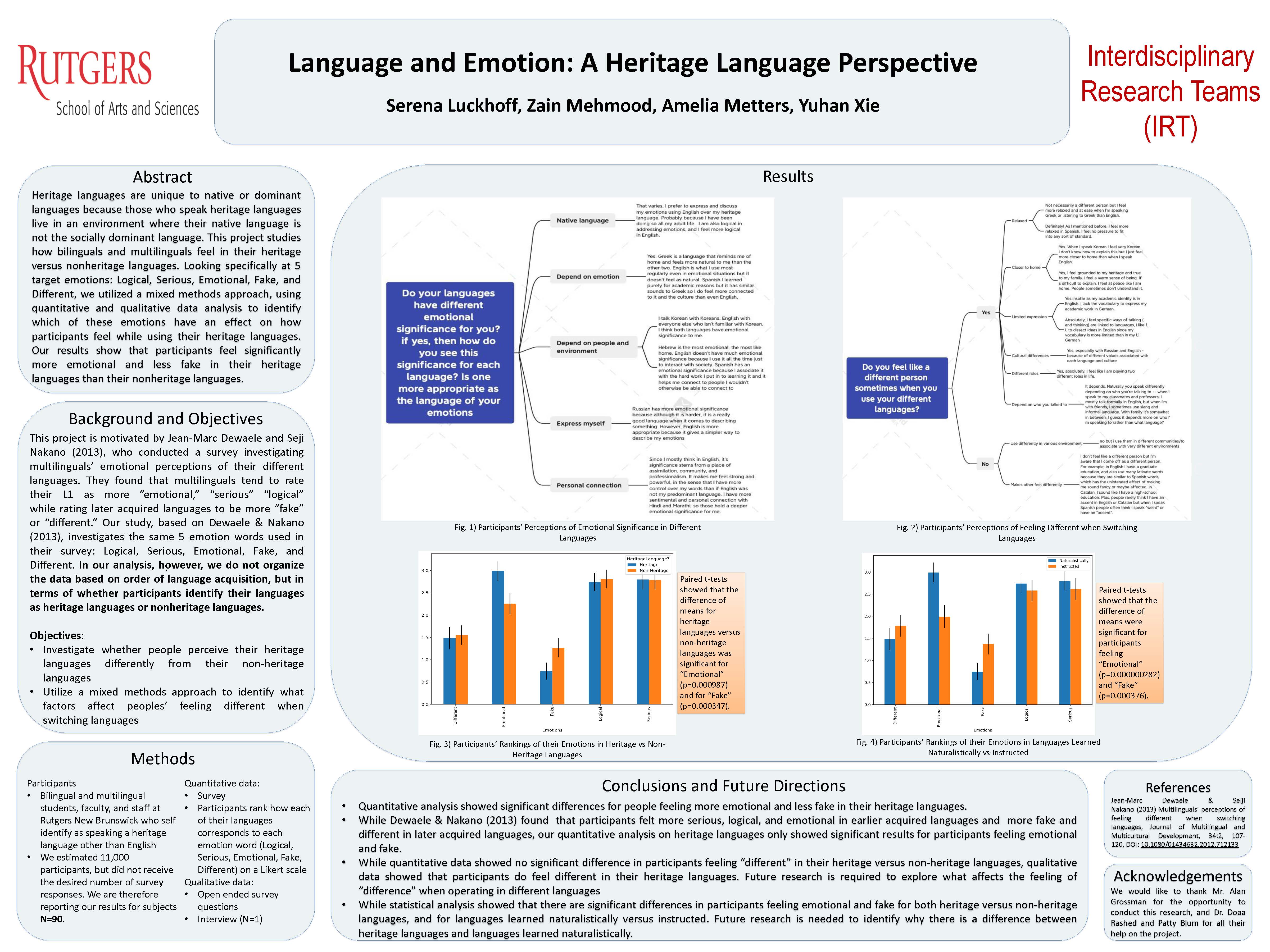
Heritage languages are unique to native or dominant languages because there is a factor of absenceor separation present -those who speak heritage languages live in an environment where their native language is not the socially dominant language. This project will study how people relate to their heritage languages, and what distinguishes a heritage language from other types native or dominant languages.
The project will consist of a quantitative component, which will be based off of a study by Jean-Marc Dewaele and Seji Nakano from2012. Dewaele and Nakano conducted a survey of multilinguals, and found that multilinguals rate their L1 as more "emotional," "serious," and "logical," while later acquired languages were perceived to be more "fake" and "different." We will conduct a similar survey, but one that does not look at order of language acquisition as an independent variable as Dewaele and Nakano did, but at language dominance and whether a language is a heritage language. Order of acquisition does not take into account what cultural setting languages are spoken in, and how this affects peoples’ perceptions of the languages they speak.
We believe that reworking this study to take into account the heritage language effect will provide another dimension to our understanding of how language and emotion interact with one another. We will also approach the concept of heritage language qualitatively, by conducting interviews of study participants who are speakers of heritage languages. Interview questions will be aimed at investigating if, how, and why a heritage language feels different from a dominant language. The qualitative portion will offer participants an opportunity to share specific details about their relationship with their heritage languages that were not able to be conveyed during the quantitative portion of the study.
Research plan including type of work. For example, work in the lab, fieldwork, library research etc. The research plan consists of familiarizing ourselves with relevant literature regarding the relationship between emotion and language from a psycholinguistic perspective, which includes the work of Jean-Marc Dewaele and Aneta Pavlenko. We will then design and conduct a survey to investigate how people relate emotionally to their heritage languages. To do this, we will apply for IRB approval. The survey will incorporate elements of the LEAP questionnaire commonly used in Bilingualism research, and the Web questionnaire by Dewaele and Pavlenko 11 (2001-2003), which yielded the results of the study that this project will be based off of. The project will also consist of conducting (presumably virtual) interviews of volunteer survey participants.
Finally, it will consist of designing the exhibit, and organizing the information collected in an easily digestible manner. What are you envisioning as the end goal of this project? I envision this project culminating in a virtual exhibit, showcasing both the results of the more scientifically oriented survey study and the more qualitative testimonials from interviews of participants. The exhibit will tell the stories of interview participants, while including visual aids such as photographs. The display of the quantitative portion will provide a unifying thread for the unique accounts of interview participants. It will convey experiences which are common to heritage language speakers, and provide the viewers of the exhibit a comprehensive, interdisciplinary outlook on what creates a heritage language. The exhibit format will also make the results of our study more easily consumable to the general public than a traditional research paper would.