• Faculty Advisor(s): Cassandra Nelson, Assistant Teaching Professor, Department of Exercise and Sport Science
  • Student(s): Emaan Abdelmeguid (Biological Sciences), Rena Chen (Biological Sciences) & Dhruv Patel (Exercise Science)
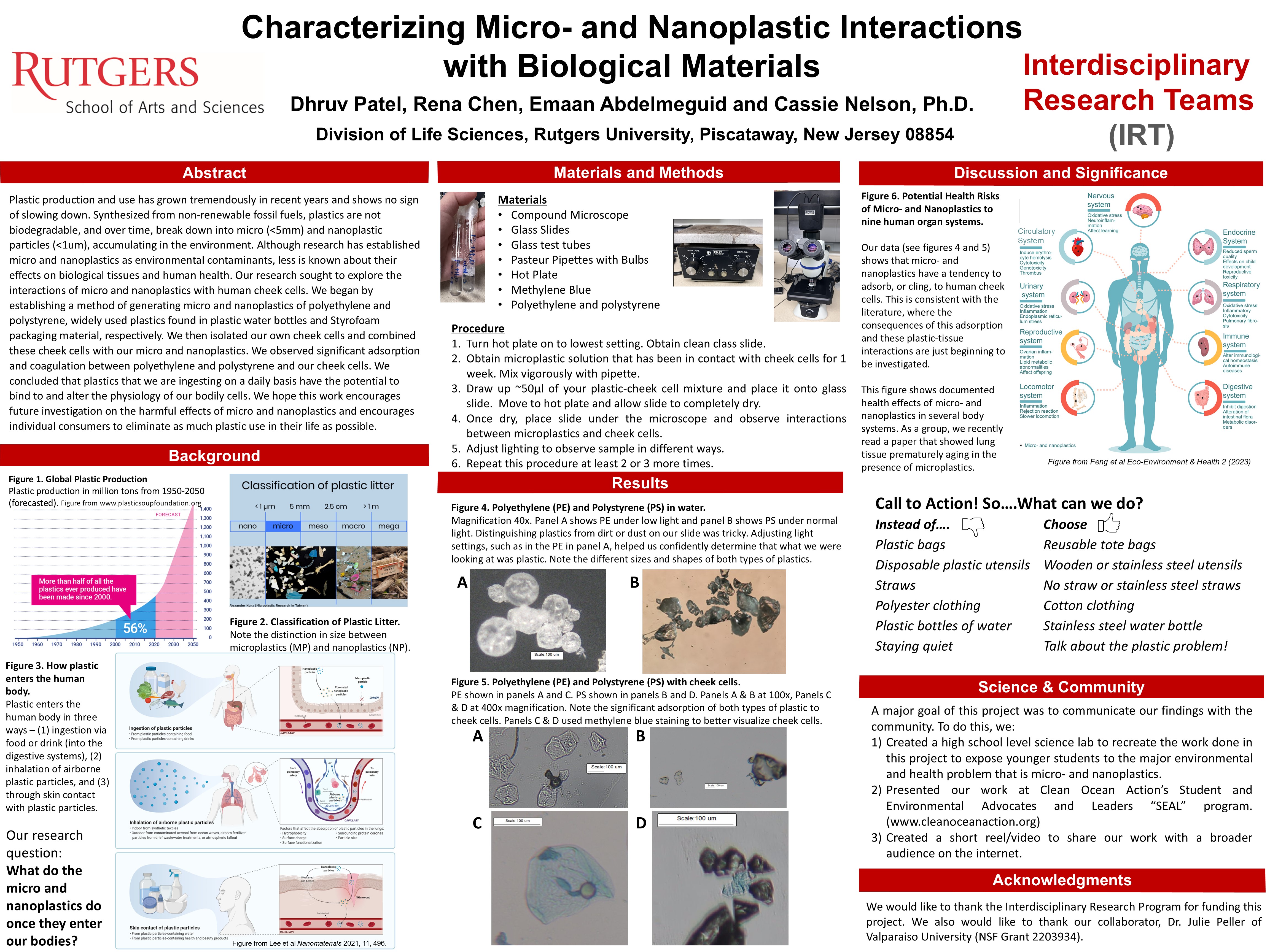
  • Project Summary: Research on micro- (MP) and nanoplastics (NP) has dramatically increased recently due to the recognition of the widespread and intense contamination posed by waste plastic materials. Since 2019, I have been a "biology consultant" for chemistry faculty member Dr. Julie Peller at Valparaiso University on microplastic research. Previous projects involved quantifying the microplastic waste in watersheds and describing how the microplastics associated with algae in Lake Michigan. Dr. Peller is currently funded by NSF (NSF 21-589) to assess micro- and nano-plastic suspensions, agglomerations, and contaminant adsorptions. The research question for this interdisciplinary project with Rutgers students will begin simply at "how do nanoplastics interact with biological materials?" Recent studies have reported that microplastics are present in human placentas, deep in human lung tissue, and traveling in our bloodstream. Students in this project will generate standard nanoplastics via a technique developed by the Peller lab and study how these nanoplastics interact with chemicals or compounds that are commonly found in the human body. For example, the most abundant blood protein is albumin. If we put nanoplastics and albumin in an aqueous (blood-like) solution, how will they interact? The hope is that students partaking in this project will be able to characterize the interactions of nanoplastics with several different compounds that are characteristic of human blood/body fluids. Research has conclusively shown that we are ingesting and excreting plastics every day. The research now needs to turn to ask the question- what are these tiny plastic particles doing as they float in the human body? This interdisciplinary project aims to begin answering that question.

Research on micro- (MP) and nanoplastics (NP) has dramatically increased recently due to the recognition of the widespread and intense contamination posed by waste plastic materials. Since 2019, I have been a "biology consultant" for chemistry faculty member Dr. Julie Peller at Valparaiso University on microplastic research. Previous projects involved quantifying the microplastic waste in watersheds and describing how the microplastics associated with algae in Lake Michigan. Dr. Peller is currently funded by NSF (NSF 21-589) to assess micro- and nano-plastic suspensions, agglomerations, and contaminant adsorptions. The research question for this interdisciplinary project with Rutgers students will begin simply at "how do nanoplastics interact with biological materials?" Recent studies have reported that microplastics are present in human placentas, deep in human lung tissue, and traveling in our bloodstream.

Students in this project will generate standard nanoplastics via a technique developed by the Peller lab and study how these nanoplastics interact with chemicals or compounds that are commonly found in the human body. For example, the most abundant blood protein is albumin. If we put nanoplastics and albumin in an aqueous (blood-like) solution, how will they interact? The hope is that students partaking in this project will be able to characterize the interactions of nanoplastics with several different compounds that are characteristic of human blood/body fluids. Research has conclusively shown that we are ingesting and excreting plastics every day. The research now needs to turn to ask the question- what are these tiny plastic particles doing as they float in the human body? This interdisciplinary project aims to begin answering that question.