
In the 2023-2024 academic year, I was incredibly grateful to receive support from the Interdisciplinary Research Program on my project “Characterizing Nanoplastic Interactions with Biological Materials.” For the upcoming 2024-2025 academic year, I would like to continue work on this project, engaging a new group of undergraduate students on micro and nanoplastic research. Thanks to the funding in the previous year, we have established how to generate micro and nanoplastics, visualize them under a microscope, and describe their interactions with our cheek cells. We have done this on dried slides, observing a static interaction between the cheek cells and the microplastics.
In our bodies, however, cells are not dry, and interactions with microplastics are not static, so the next step in this research is to observe the interactions of the cells and the microplastics in an aqueous, physiological solution. To do this, we will need to use stereomicroscopes (as opposed to compound microscopes) and depression slides. We will also need to create a physiological solution where the cheek cells can stay alive and intact. Observing cheek cells and microplastics in an aqueous solution can give us a better understanding of why and how these two things interact.
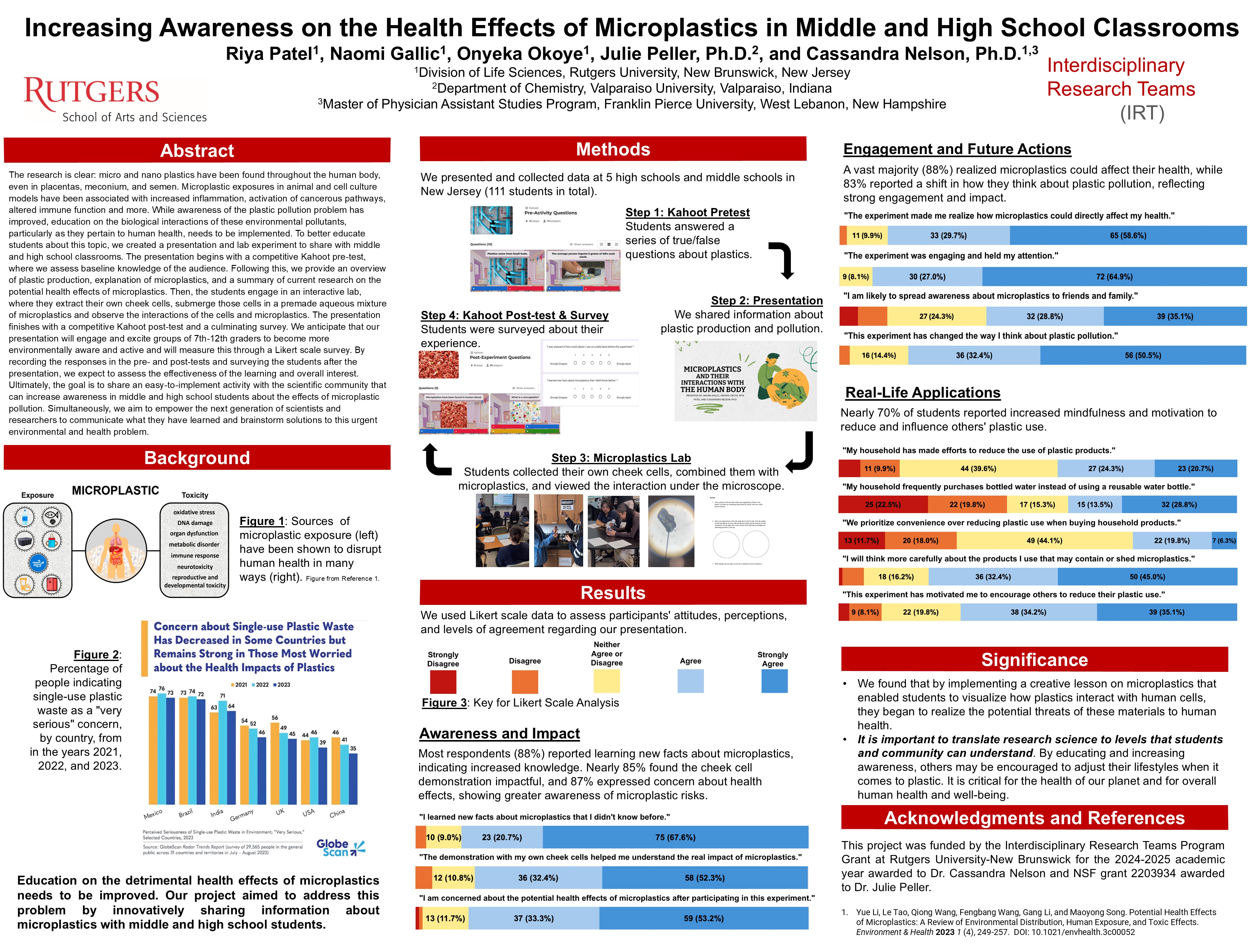
My 2023-2024 group of students have worked to disseminate their research by creating a 3-week lab experiment at the high school/early undergraduate level (will be part of the April 2024 presentations). I would like to bring this lab created by this year’s students to high schools and places on campus where teachers and students can be carrying out these experiments on their own. Ideally, over the course of the 2024-2025 academic year, several classes would partake in the lab created by the 2023-2024 students, and we can gather data on how well the lab works, how to improve it, and if the lab helped raise the students awareness of the role of microplastics in our lives and our bodies.
Thus, my proposal to continue my work in the Interdisciplinary Program will include the following:
(1) Having the opportunity to train 3 new students in research methods, as all my current students are seniors.
(2) Continuing to optimize our visualization of cheek cells and microplastics by creating a physiological, aqueous solution and potentially viewing their adsorption to one another in real-time.
(3) Continuing to promote the work in the community – presenting for high school students, running the lab with high school students and/or undergraduates, and presenting at other community functions.